Study Guide
Field 142: Social Studies (7–12)
Sample Multiple-Choice Questions
Expand All Answers | Collapse All Answers
Subarea 1—Professional Dispositions and Responsibilities in Social Studies
Objective 001—Practicing Continuous Improvement
1. A high school establishes professional learning communities (PLCs) consisting of teams of teachers, counselors, and special education professionals and paraprofessionals to reflect on and improve educational practices within the school. A world history teacher at the school supplements this PLC with mostly online participation in a network of teachers and professors of world history from across the United States and several other countries. This second professional learning network is most likely to improve the teacher's practice in which of the following ways?
- deepening content knowledge
- reflecting on ways of building trust
- developing classroom-management methods
- using student assessment data to improve planning
- Answer. Enter to expand or collapse. Answer expanded
- Correct Response: A.
Objective 002—Exploring Cultural Frames and Diverse Perspectives
2. A high school world history teacher prioritizes creating a more inclusive learning environment for students. The teacher seeks out professional development opportunities related to issues of diversity, equity, and inclusion and attends a workshop. During the workshop, the teacher engages in self-reflection on their own cultural frames and potential biases. Which of the following statements describes a challenge the teacher may face while attempting to identify their own cultural frames?
- They may not recognize they have a cultural frame if theirs is the prevailing culture.
- There is little agreement among social scientists about the definition of culture.
- Technological innovation has expanded the influence of the prevailing culture.
- They may feel connected to more than one cultural frame.
- Answer. Enter to expand or collapse. Answer expanded
- Correct Response: A.
Objective 003—Taking Informed Action
3. A high school teacher instructs several different social studies courses, including civics, world history and geography, and U.S. history and geography. In teaching the civics course, the teacher delivers extensive, varied instruction about democratic values and their role in responsible citizenship. Beyond this type of direct instruction, which of the following teaching practices should the teacher use in all courses to establish and uphold democratic norms in the classroom?
- designing instruction to connect historical and geographic topics to contemporary global issues
- modeling standards of reasoned discourse by acknowledging the validity of contrasting viewpoints
- encouraging students to consider the strengths and limitations of claims and refine them accordingly
- using a grading system that allows students to show competency through a wide variety of intelligences
- Answer. Enter to expand or collapse. Answer expanded
- Correct Response: B.
Objective 004—Ways of Knowing
4. A high school civics teacher plans a unit focused on public issues at multiple levels. One of the teacher's goals for the unit is for students to use multiple sources of evidence to develop and support arguments. The teacher can best support this goal by including which of the following activities as a culminating project for the unit?
- participating in literature circles on selected readings related to contemporary social issues
- writing to tribal, local, state, and federal elected officials in support of selected public policies
- organizing fundraisers for nonprofit organizations that support project-based learning in the classroom
- researching tribal, local, and regional issues, then crafting and presenting policy proposals to address issues of their choice
- Answer. Enter to expand or collapse. Answer expanded
- Correct Response: D.
Subarea 2—Social Studies Learners and Learning
Objective 005—Understanding Social Studies Learners
5. A high school economics teacher conducts a unit about how prices are determined by buyers and sellers in a market. Over a period of days, the teacher uses the example of hypothetical "widgets" manufactured and sold by producers and then purchased by consumers. The teacher uses supply and demand graphs of the market for widgets to illustrate how changes in the market affect the equilibrium price. The teacher observes from students' discussions that few comprehend the full meaning of essential concepts. In light of this observation, the teacher should take which of the following actions to modify the lesson sequence?
- implementing longer wait time so that students can formulate their thoughts while grappling with the inherent complexity of market interactions
- engaging students with a project that involves interacting with each other to create three-dimensional market graphs and other models
- providing students with more concrete and realistic examples of market interactions that are drawn from their experiences
- supplementing instruction with a variety of primary and secondary sources that represent diverse viewpoints on markets
- Answer. Enter to expand or collapse. Answer expanded
- Correct Response: C.
Objective 006—Creating an Inclusive Learning Environment
6. A high school world history teacher prioritizes using multiple perspectives to create an inclusive classroom experience for their students. Which of the following learning activities would best align with this goal?
- identifying the historical context in which significant artifacts were created
- responding to a daily warm-up question that connects the lesson to the local community
- analyzing historical events from the point of view of historically marginalized communities
- evaluating primary and secondary sources as a class to identify examples of potential bias
- Answer. Enter to expand or collapse. Answer expanded
- Correct Response: C.
Objective 007—Preparing Learners to Be Informed Participants
7. A high school world history teacher prepares students for a graded discussion during a unit of study on the history of global protest movements, including various viewpoints on the U.S. civil rights movement in the 1960s and the anti-apartheid movement in the 1980s. To prepare students for the discussion and facilitate collaborative discourse, the teacher establishes group norms. Which of the following norms would best support constructive student group discussion?
- Support opinions with evidence from social media.
- Look for opportunities to recognize multiple perspectives.
- Corroborate secondary evidence with firsthand accounts.
- Consider the causes and consequences of historical developments.
- Answer. Enter to expand or collapse. Answer expanded
- Correct Response: B.
Subarea 3—Planning and Implementing Instruction and Assessment in Social Studies
Objective 008—Planning for Instruction and Assessment
8. A high school U.S. history teacher seeks to collaborate with colleagues from the English language arts department to implement a project-based curriculum. Together, they decide on the 1920s as a historical era to study alongside the literature of the Harlem Renaissance. At the end of the unit, the students curate museum exhibits in a public part of the school to share their learning. Which of the following collaborative models would best support the teachers in successfully executing this kind of cross-disciplinary curriculum?
- parallel teaching
- common planning time
- peer learning communities
- structured professional development
- Answer. Enter to expand or collapse. Answer expanded
- Correct Response: B.
Objective 009—Implementing Instruction
9. An eighth-grade social studies teacher completes a unit of instruction on the Patriot and Loyalist factions during the American Revolution with a group of culturally diverse learners, many from immigrant and refugee families who escaped violence and political persecution in their home countries. The teacher prioritizes facilitating engaging group discussions that incorporate the class's varied perspectives. The teacher gives students class time to prepare notes for discussion as a formative assessment. Which of the following discussion questions would best support an engaging student discussion?
- "Is the signing of the Declaration of Independence the most important moment in American history?"
- "How many Loyalists were wounded in battle during the American Revolution?"
- "Why did some Loyalists stay in America while others fled to Nova Scotia?"
- "For what set of reasons did the American Revolution happen?"
- Answer. Enter to expand or collapse. Answer expanded
- Correct Response: C.
Objective 010—Inquiry-based Instruction in Social Studies
10. A first-year high school social studies teacher attends an education conference for professional development. One of the teacher's goals for the event is to learn more deeply how to use the Inquiry Arc in the College, Career, and Civic Live (C3) Framework for Social Studies State Standards to make inquiry the foundation of disciplinary knowledge. The teacher specifically wants to gain actionable insight about methods of designing instruction that supports students in evaluating historical sources and using evidence, according to Dimension 3 of the C3 Framework. Which of the following sessions should the teacher attend to support that goal?
- Integrating Emerging Technologies into the Teaching and Practice of Civic Engagement
- Structuring Instruction with Effective Use of Compelling and Supporting Questions
- Reevaluating the Impact of the New Deal on Marginalized Communities
- Using Tools to Strengthen the Precision of Claims and Counterclaims
- Answer. Enter to expand or collapse. Answer expanded
- Correct Response: D.
Subarea 5—Economics Content Knowledge
Objective 013—Applying Disciplinary Concepts and Tools in Economics
11. A high school economics teacher plans a unit about the costs and benefits of international trade for individuals and nations. The teacher delivers instruction on the principles of absolute advantage and comparative advantage to the class. The teacher should be aware that, relative to absolute advantage, the principle of comparative advantage is:
- a more counterintuitive idea because both countries can benefit even when one country has an absolute advantage.
- a concept that leads to the conclusion that at least one country is harmed from engaging in international trade.
- a more complex concept because it involves the interactions of three or more countries.
- a more theoretical construct with fewer real-world applications than absolute advantage.
- Answer. Enter to expand or collapse. Answer expanded
- Correct Response: A.
Subarea 6—Geography Content Knowledge
Objective 014—Applying Disciplinary Concepts and Tools in Geography
12. A high school world history and geography teacher plans a culminating unit of instruction on contemporary global issues, including the distribution of population across rural and urban settings, the distribution of wealth and resources, and the effects of humans on the global environment. In addition to text resources, the teacher provides students with a variety of data displays and maps showing evidence about past and present distributions of population in selected world regions. The teacher should also include aerial and satellite imagery in the unit to help students explore which of the following issues?
- how increases in population density have affected the standard of living in those areas
- how recent changes in patterns of migration have affected people's perception of regions
- whether areas of land have changed from green vegetation zones to gray urbanized areas
- whether changes in the use of energy resources have had an effect on water temperatures
- Answer. Enter to expand or collapse. Answer expanded
- Correct Response: C.
Subarea 7—History Content Knowledge
Objective 015—Applying Disciplinary Concepts and Tools in History
13. A seventh-grade social studies teacher plans a lesson sequence exploring major characteristics of the Qin dynasty of ancient China. The teacher plans to include the painting1 shown of the burning of books and execution of scholars under Qin Shi Huangdi in 213 BCE.
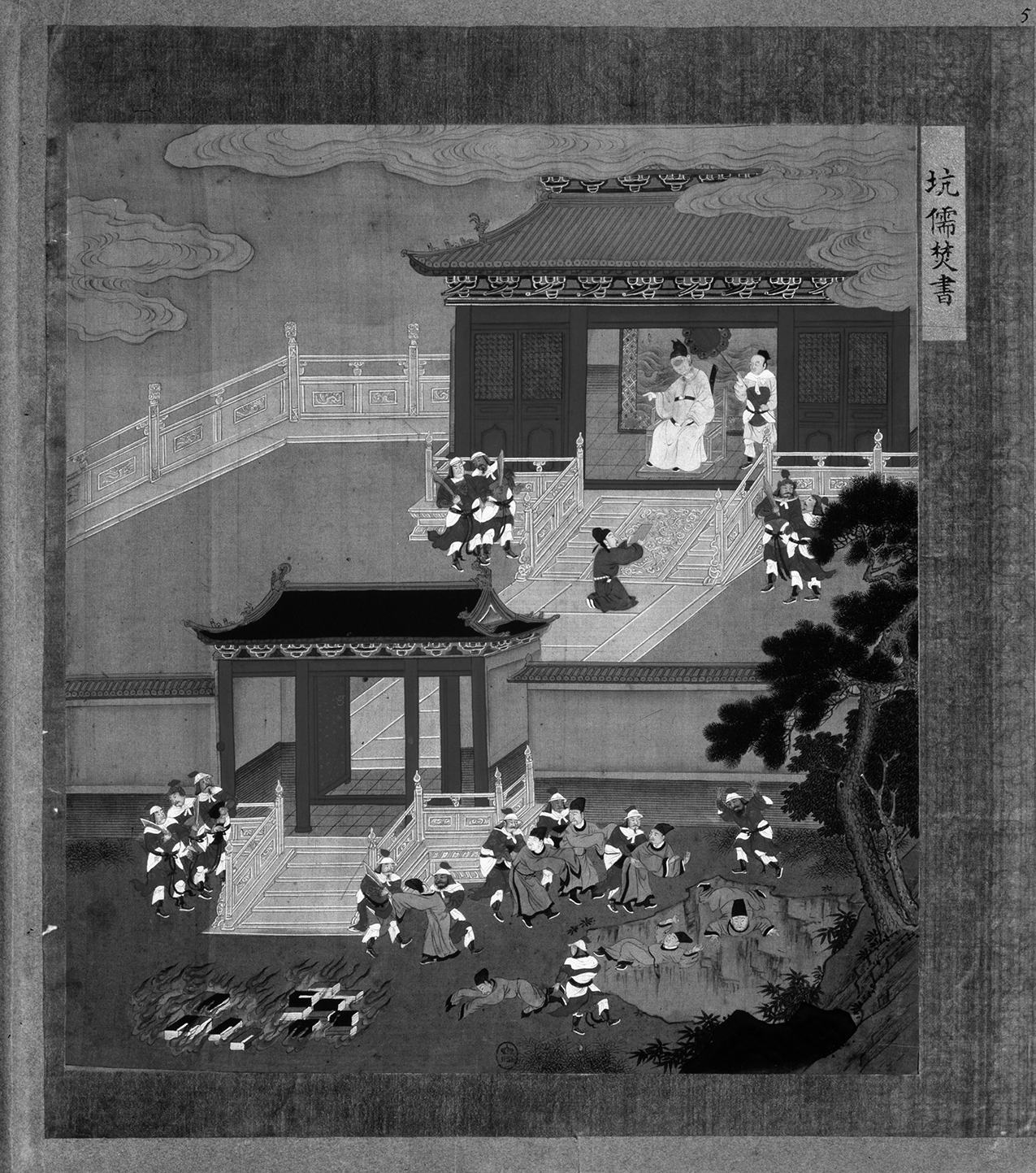
A painting depicting the enlarged figure of the emperor, Qin Shi Huangdi, sitting on a throne in an open building among the clouds, protected by a palisade and uniformed guards armed with swords. A servant stands to the left, fanning the emperor, who gestures with his right hand to a kneeling messenger. Outside the enclosed area is a small gatehouse, in front of which a pile of books is in flames as several robed scholars are forced into a pit under a tree and buried alive by soldiers.
The teacher could best use this painting to prompt a student discussion about which of the following reforms promoted by the Qin dynasty?
- centralization of power and standardization of administrative systems
- support for the diffusion of elements of material culture from other classical civilizations
- expansionist diplomatic relations and military dynamics between the Qin and neighboring states
- economic restructuring leading to the forced labor of peasants and convicts under state-sponsored construction projects
- Answer. Enter to expand or collapse. Answer expanded
- Correct Response: A.
Multiple-Subarea Passage
Use the information below to answer the two questions that follow.
A high school civics teacher plans a unit during which students explore the branches of the U.S. federal government, the separation of powers between the branches, and the checks and balances exercised by each branch on other branches. Class discussions tend to revolve around the complex distribution of powers between theexecutive and legislative branches.
Objective 011—Assessing Student Learning
14. The teacher has the 30 students in class complete an exit ticket. For the ticket, students classify functions and powers as belonging to either the executive branch or the legislative branch. A summary of student responses and correct responses is shown.
| intentionally left blank | Executive | Legislative |
|---|---|---|
| Appointing Ambassadors | 26 (correct) |
4 |
| Declaring War | 19 | 11 (correct) |
| Funding or Withholding Funding | 23 | 7 (correct) |
| Ratifying Treaties | 14 | 16 (correct) |
| Vetoing Bills | 28 (correct) |
2 |
Patterns in the data support which of the following conclusions with regard to the state of students' sense-making on the legis?
- Many students are not aware that the War Powers Act of 1973 has affected the separation of powers regarding that issue.
- Most students need to have their understanding of the categories challenged by being asked more difficult questions.
- Many students may not know whether Congress can override a presidential veto.
- Most students regularly underrate the powers that properly belong to Congress.
- Answer. Enter to expand or collapse. Answer expanded
- Correct Response: D.
Objective 012—Applying Disciplinary Concepts and Tools in Civics
15. The teacher can best use which of the following activities to support students' understanding of the powers of Congress?
- conducting a mock national election with students acting as members of the Electoral College
- researching congressional candidates in groups and reporting student findings to the class
- examining the majority opinion of the Supreme Court case United States v. Nixon
- engaging in a close reading of Article I, Section 8 of the U.S. Constitution
- Answer. Enter to expand or collapse. Answer expanded
- Correct Response: D.
Acknowledgments
1acknowledgement 1 Huang Ti, founder of the Qin dynasty burned all Chinese books and precipitate literate people in a pit, 18th century (miniature). Location: Bibliotheque Nationale, Paris, France. Photo © Photo Josse / Bridgeman Images./ [Item]